
An Open Letter To My Little Niece
My darling Ria,
You are about three months old. A tiny ball of innocence. Uncorrupted and carefree. Oblivious to most everything, but maybe for once, oblivious with reason, with an inability to process anything, because your brain is still figuring everything out. You have a slight dent in your head because that little brain of yours needs to grow. It will bloom with the wonders of the world, constantly challenged by temptation that it will sometimes give in to. But, that’s okay. You will find that balance, that serene peace with yourself that your mother embodies and that sheer strength your mother personifies. Your mother’s ability to reason emotion will pervade your wondrous life with awe, with the right medicine at the right time, and you will forever be loved.
If you do ever read this, a few decades down the road, remember that I am (or used to be) a wannabe-poet. So, I have been forever finding a way to take the cheese out of the cheesy. It’s hard, and to be fair, it’s a two-way street. I hope just the right amount of cheese melts away at your sentiments as you read through this. I think innocence, life and connection warrant infinite emotions.
There are a few things I want to say to you.
I’ve had the honor and the privilege of changing your nappies. I have put you to bed more times than once, sometimes to the music of someone I love. I have danced embarrassingly in front of you way more times than I would like to admit, but you never judged me. You looked at me, sometimes confused, sometimes with a smile, and sometimes, you danced yourself. Yes, most un-smitten people would call your dance, “cycling leg movements, coupled with offbeat hand gestures, topped off with constantly evolving eyebrow thrusts”. But I’m smitten, so I hope you dance all your life, with or without rhythm, with or without music, but with a whole ton of heart.
I am proud to say that you are also a master burp-er, one that even we, your mother’s burp-tastic side of the family, celebrate with awe. Your baby farts give adult farts a run for their money, making you, quite the Rockstar among your peers. There are limited ways for you to communicate at this age, so I love how you make the most of what you have.
We are still far from figuring out what your hair color is, and what your eye color will morph into, but the bets are on. Your golden skin is the perfect blend between your pale father and your dark mother. You have your dad’s eyebrows but your mum’s eyes, your dad’s chin and your mother’s nose, but your smile is a delightful combination of them both, and everything nice. Your legs, though, are more like “tangdi kababs”, but that will change.
When you cry, it’s like the world has gone still. All the chaos in my head is concentrated on yours. Because you are too young to cry without reason. So, it’s time to play detective, and comfort the discomfort. But I think I am a pretty bad detective, so I play more of the “throw-everything-at-it” game – music, books, soft toys, taking you in my arms, singing off-key, dancing, pretending everything is okay, and somehow something works.
When you look into my eyes and smile, there is an explosion of joy. Your face lights up like a few million stars clustered together in the clear sky, luring me into finding my own happy stars. It’s amazing how powerful your tiny fragile little self can be.
Right now, I am looking at you and you are fast asleep. Yes, that sounds creepy but I feel comforted when I see your chest move up and down. You can call it paranoia, but it comes from a good place. I probably won’t get to spend as much time with you as I want to. You can thank ambition, distance and a laundry list of excuses for all that. But you will always have a piece of my heart, my soul, my brain or anything else you grow up to believe is the right form of the emotional self. You are in the best possible hands. Your mother is my second mother from the same mother – she is already a pro at this, and you are lucky to have her as your guardian. Your father is as sharp as a knife, and this combination of reason and intelligence sets you up to be the ultimate hybrid baby.
Here’s to dancing your way through life, clasping on to innocence as long as you can, with a few burps and a few farts along the way.
A timeless hug,
Your Mamu, Anish.
“Legalizing” Social Enterprise
“I want to make a social impact.” — That’s almost a trend right now in the minds of millennials, young professionals and students in general. It’s cool to care, and I love that this is becoming a thing. I am proud (or guilty — however you want to view it) of falling under this spell. But, one thing that bothers me about this hypnosis is the absence of an official, legal recognition of the golden child that is social enterprise.
Yes, “social impact” is and should remain vague enough as anything that does good for humanity and / or the environment. “Non-profits” have a whole IRS section associated with them and are wonderfully defined — I do have issues with calling them non-profits vs something more optimistic like “for-purpose” or “for-impact,” but that’s just semantics — am content with their legal formalization. Woohoo. But, why can’t we do the same for social enterprises?
Social enterprise to me is the future. The idea of having a financially-sustainable social impact business is mesmerizing because it is arguably immune to a sometimes-crippling dependence on donations and grants. What is even more enticing is that a social enterprise is still open to donations and grants, but those donations and grants can be used on growth strategies instead of sustenance — investment in scale, prototyping a new idea, or buying a Super bowl commercial (why not?)
The issue amidst this gold dust is that there is no legal definition of a “social enterprise” in particular. I think it is time we have one. Just like we have a section for non-profits in the IRS, it is time to make room for social enterprises as well, and not just in the U.S., but around the globe. Throw in some significant tax-breaks too if possible. Incentivizing social enterprise can play a key role in increasing the rate at which we make the world a better place.
And a lot of the hard work is already done. B-corps, ironically a non-profit organization, is already doing a stupendous job of certifying organizations that put social impact over profit. Benefit Corporation, almost an offshoot of B-corps, goes a step further to provide legal protection to social organizations from shareholder law-suits.
There is also a somewhat universal acknowledgement of what a social enterprise is, or at least everyone is beating around the same bush. For instance, Stanford Social Innovation Review — arguably the leaders in inspiring leaders of social change — took a whack at the definition, and hit on the right nodes — financial sustainability and primacy of social impact. But they also roped in this complex notion of “shifting the equilibrium” (like Apple did with the iPhone, but in the social impact space). In theory, this equilibrium-shifting ambition is hunky-dory, but puts excessive pressure on a social enterprise and severely filters out a lot of social businesses. Plus, it is excessively subjective in an already subjective space, and does not help if we want a legal corporate framework for social enterprises. Mohammed Yunus also threw in his definition of social business (yes, some people say business, some enterprise, semantics again, but let’s get our nomenclature consistent already FFS). He is also in the same ballpark and stresses on the importance of putting social impact first, and over (not side by side) profit.
My personal view is very aligned with this. Putting social impact over profit also separates social enterprises from enterprises that have a social impact. That’s not just a play on words, that’s real. Google can have a tremendous social impact, but it is not a social enterprise because its primary purpose is not to drive social change. It wouldn’t deserve the shiny gold dust.
The other breakthrough in this space is the focus on a stakeholder-centric model over a shareholder-centric model. Jaqueline Novogratz, the founder of +Acumen, embodied this in her year-end note to donors:
“As it becomes clear that business must move away from shareholder primacy, we are doubling down our investments in companies that unapologetically consider all stakeholders — starting with the poor — at the heart of their purpose.”
So, there we have it — a concept that has significant differentiation, a definition that is somewhat consistent across the board, an organization that is doing a stellar job at certifying social impact organizations and a level of legal protection for “Benefit Corporations” in many states in the U.S. The only thing left is to STOP beating around the bush, take motivation from the precedence set by non-profits / for-purpose organizations and write out a section 501(c)(15) (or whatever) that legally sanctifies social enterprises. Like non-profits, they should receive some sort of a tax-break, maybe not a full tax-exemption, but a significantly lower tax rate on their net income. They should be allowed to have an IPO, but with enough controls in place to ensure their social impact vision and their key stakeholders are not compromised. This is crucial to encourage and incentivize social enterprises.
We need to use all our ever-increasing human IQ and EQ to come up with financially sustainable solutions that put real social impact first. We need to differentiate true social enterprises from wannabe-social enterprises. Or else, we’ll have Joe’s Carwash call itself a social enterprise because they use natural tap water.
Personally, I hope that fifty years from now every single enterprise is a social enterprise, especially in the developed world. And no, not the Joe’s Carwash kind.
P.S. Impact Investing — you’re next.

Guatemala, You Beauty
There is so much to say. Guatemala has opened its arms and embraced me with nothing but love. And yes, all this sounds corny, but contentment breeds corniness, fortunately or unfortunately.
I am not going to lie, I was a little scared. Everyone and their mothers couldn’t stop warning me about the dangers that engulf this Central American country. And then these other mothers spoke to my mother, and filled her up with bother, and that was not fun either. And then there was this other brady bunch that didn’t know what "Guatemala" was. All in all, the uncertainty of where I was going, and the certainty that I was going to be robbed as soon as I got off the flight, made it all very interesting off the bat.
I landed, and I did not get robbed. I met a friendly taxi-driver who friendly-ly drove me to the bus station, where I got on a friendly bus, and made it to the friendly city of Xela some four hours from the capital, where I was greeted by my friendly Spanish teacher, who took me in a friendly cab to my super-friendly host family, and all this friendly hospitality made me all giddy inside. It’s not to say that Guatemala is not dangerous at times, but it’s like any other developing country – if you do stupid things, and go to stupidly dangerous places, or get ridiculously unlucky, something not-so-fun might happen. I know of friends who have been robbed at knifepoint even in New York.
After flushing this unreasonable fear out of my system fairly quickly, I was in dreamland. Yes, the showers here are not great, the internet is choppy, the lights go out occasionally coupled with a mini-earthquake or two, but all that has not mattered. I have been happier than I have ever been in my whole entire life (remember contentment = corny?), and my problems are trivial compared to the seismic schizophrenia Corporate America used to give me. I know what I am trying to achieve, where I am trying to go and I am no longer dreaming about it, I am actually doing it. And it has all made sense so far. I spent my first month learning Spanish in a school exploding with love and goodness. My teacher was the personification of patience and prudence, and dealt with my constant self-destruction, sublimely. I was grounded a little because I thought I would be rattling off Spanish in a month, but learning a language is bloody hard, and jawbreakingly frustrating. But the folks at the Sisai School of Spanish made it easier. Every weekday, after five hours of Spanish class, the teachers took turns in taking us students on local excursions and activities. And these weren’t just any excursions, these were well thought-out, immersive experiences that you would only get if you spent enough time with the local folks out here. We went to secluded towns adorned by zero tourists, but instead by the warmth of the local Mayan people. We explored the legend of San Simon and the beauty of Mayan philosophy (I am getting an “El Ajau” tattoo before I leave.) We did Salsa classes and cooking classes, played football and crammed ourselves in the back of a small pickup along with twelve other people who magically found ways to make room where room didn’t exist. We learnt about the city, about the people, and we danced together, sang together, ate together and drank together. It was a glorious time with a glorious group of genuine people, and I was so overwhelmed by their warmth.
The people here are something else. There is a genuine flow of love right from the way everyone greets each other, to how everyone respects each other, and to the way everyone treats one another. I missed this in the States and in Dubai, so I am going to embrace it. And embody it. As much as I can. My host-family took me in as one of their own, and my host-mother became very quickly my second mother. They fed me like their own child, and showered me with all the picante they could muster, as soon as they figured out that spice was my thing.
After a month of drowning myself in Spanish, it was time to begin my fellowship. And this moment was really important for me. It was like I had waited all my life to finally start doing exactly what I wanted to do – and not just any random thing, but finally landing on the road that I had created, that is headed in exactly the direction I want it to go in. It is so liberating and so empowering. And believe it or not, the one month I have spent at this fellowship has totally lived up to the hype. I am still in Disneyland and this honeymoon phase isn’t ending as of yet. I hope it never does.
If you have ever thought of doing something like this, do it right now. Don’t let these rules created by society control you. It’ll be the best decision you ever make.
P.S. Indians are pretty non-existent here in Guatemala (I thought we were everywhere?) I seriously think there are only two of us in Xela – one chef / owner of the BEST restaurant in town, and me. So yes, I now know what it somewhat feels like to be Icelandic in just about any country except for Iceland.

Goodbye America
I am sitting here, at the O’Hare International Airport. Where I sat exactly ten years ago, waiting for my uncle to pick me up, as I made my first foray into these United States. It is fitting then as I say goodbye, a full circle of sorts, almost an inverted poetic mime.
I came here as a naïve, skinny, innocent Indian boy, full of principles and hope. I was fortunate that an American University education was very much part of the script, so despite this being a land previously uninhibited by my body, it was the obvious choice. Wide-eyed and eager, I thought monobrows, untamed hair and sobriety was all naturál, and I preached my pride – like me as I am, I don’t need to fit in.
And then the first girl gut-checked my heart, and then another, soon followed by some social punches, and that led to my first American epiphany – I had myself all wrong. I do need to fit in, at least just enough. So, off went the monobrow, and after a beer in Spain with my sister and a trip to the hairdresser, almost everything changed. Even though I spoke with a weird accent, I was suddenly more American than ever, with spiked hair and a red cup of beer in my hand. I not only attended house parties, but we started hosting our own, making sure there was always enough alcohol at our apartment, a thumping set of speakers, and the ultimate utility – a sofa bed. Hip-hop was suddenly bearable and became skeet-skeet melodic after several nights out on 6th street in Austin, Texas. I started listening more to Kanye and Lil Jon and less to Robbie Williams.
My life was suddenly governed by the notion of work hard and play hard. And I worked hard to earn my right to play. I blossomed academically, especially once I realized that I might have had a head start in the theory of things, but my application abilities needed major reform, and that was glorious. I was suddenly double-majoring and minoring, doing laundry for the women’s university soccer team (plus ball tending), and became President of brown-town. But, most importantly, I was surrounded by the right people. I made the best of friends, and amidst all the chaos, those friendships were the ultimate sustenance. I don’t ever want to go back to college, not because it wasn’t the best time, but because I can’t imagine the thought of not making the same friends as I did.
Getting a job after college was not an achievement, it was an expectation. I entered Corporate America, ready to rock, and it was quite the concert. I got a finance gig with a media company, and even though my passions back then lay in sport, I justified the opportunity for the money, the stability and obviously, the work-visa sponsorship.
I entered the workforce brimming with confidence. I was supposed to be stellar at Excel, and a paycheck meant independence. But this confidence combusted quickly. When I saw my boss work his magic, I realized I wasn’t really that good at Excel. Or anything. I was also quite an anomaly in our little San Antonio office – the only Indian person in an office surrounded by Tom, Greg, Matt, Mark, Brandon and Brian. Yes, all white men with the whitest of names, and they were all lovely. By now, I had mastered the art of fitting in. So, I quickly put on the best make-up I could find and slotted myself in.
I worked hard. Really hard. San Antonio is a dead city which was an incentive to work harder. I was absorbing, learning, growing and adding a ton of value. Suddenly, I was actually good at Excel, and PowerPoint, and Finance, and story-telling and analysis. And then, the dream was realized – I won myself a promotion to New York. Here I was, a kid who spent his first nine years in Aurangabad, about to move to the greatest city in the world. It was too good to be true.
New York, you beauty! The city is the best that America has to offer. The diversity, the nightlife, the food, the people and the excellence are all intoxicating. You can pursue whatever you want and find a mini-verse dominated by professionals and experts milking their passions into excellence. It’s intimidating and inspiring. I found my click in the spoken-word poetry universe and started playing for an amateur football (soccer) team. We were just the right amount of committed – it was for fun, but we wanted to win. We had a manager and late-night practice sessions on Wednesdays. Only in New York will you find enough folks committed to a 10-pm “practice” session on a workday. Meanwhile, the dating scene was incredible and tragic at the same time. There were so many single people that flings were easy, but commitment was hard. Why commit when there might be someone else out there that is better? It was fun at first, and then harrowing, all the while, bloody expensive.
Professionally, I worked even harder in New York. I was promoted every year and was soon leading a team of six. They liked my work and wanted to “clone” me. So, I was hiring and training and deploying. The learning curve was steep, and I loved it. I was adding value and working almost directly with the CEO of the company. It was stressful. I was always on call – whether on vacation or late at night. Not quite like a doctor, but close enough. Definitely not as important. The weekdays were especially hard, so the weekends meant it was time to let loose. I partied harder than I should have because I “deserved” it after a long week at work. The weekdays were stressful, the weekends blurry.
This was a time of extremes – lots of learning, growing, earning and “enjoying” but it was also lonely, depressing and conflicting. I was breaking a little. I was hard on my team. I could barely stay in a relationship. And I was starting to not like myself. What’s the point of working so hard and then not liking yourself? What’s the point of working so hard to make some rich people richer? Why am I not putting all this effort into solving real problems of the world? I had made the money, conquered my dreams of being in New York, partied, traveled and I was still unhappy. That’s when I realized this was not it. This could not be it.
Thus, began some good old soul-searching. I started reading again, thinking, contemplating, prioritizing. And then it all started coming together. It was time to take everything my past had blessed me with and do something useful with it. My sister bestowed upon me the concept of social enterprise that had been lying dormant in the back of my mind somewhere. I dug deep to encounter that injustice really bothered me, and how were we okay with this? Poverty, I think, is one of the greatest injustices in today’s world. How can we be landing on the moon and have poor people at the same time? Problems are fun to solve. What if I take what I know and try to solve a problem that makes a positive difference in the world? Fighting poverty through social enterprise? Bingo. So, I quit.
After spending nine years in India and nine years in Dubai, this ten-year chapter in the United States of Immigrants has been my longest, and the most enriching so far. American higher education is the most flexible and the best, especially if you want to learn and grow, but it comes at the expense of innocence. Maybe that’s okay. Corporate America is the most functional economic art in the world, but draconian capitalism allows for the ignorance of morality. While the governments of developing countries are marred with corruption, the private sector of America has its own demons to battle, and the financial sector needs a schooling in ethics. My professional growth came at the expense of some corrosion, and that, for me, is difficult to swallow. So, getting out of Corporate America feels like a liberation of sorts, but don’t get me wrong, I have no regrets. No good adult story is all hunky-dory, and it is the lows that help etch the statue of your principles.
Thank you, America, for everything. You have been the capstone to my learning experience. I am ready to unleash everything that I have learnt where I think it matters the most, and I have never felt more prepared for my next chapter. As you try and prevent yourself from imploding with all the current political turmoil, I will let you be. I am one less immigrant to worry about.

P.S. America, you let me embrace spoken-word like I could have never had anywhere else. You got me on stage, and allowed me to be as dramatic as I wanted to be, as I tried to rhyme my emotions. Cheers for that!
The Effective Altruism Movement + EA Global Conference, Boston
Effective Altruism (EA) is a movement. I was at their conference in Boston last month, and needless to say, I was moved. Here’s my take.
Effective Altruism is literally what it says it is. It is doing good, as efficiently as possible. It’s optimizing philanthropy. It’s doing good, better. They would be hypocrites if they didn’t come up with an efficient name. So, for instance, if you’re an engineer by trait, and you quit your job to go to Vietnam to teach English, you’re essentially wasting your stellar engineering skill-set and not being effective. At that point, if you were an Effective Altruist, you would seriously question your decision – am I really making the most impact possible by teaching English versus let’s say, engineering a way to build huts more efficiently?
So, how is this a movement? In my opinion, it is a movement because it urges you to break conventional thinking. Should you donate to a charity based on your emotions (I love dolphins and they are being killed)? Or should your dollar go where it makes the most impact (deworming does not sound fun, but might be a more effective use of your money)? It is a theory, a state, a science, a way of thinking that encourages demands that you give back in the most scientific, data-driven, efficient way possible – whether it is through donations or your skill-set. As a quant guy, this resonates with me wholeheartedly. Why would you not want to make the most impact possible? But, if you’ve lost your little sister to cancer, it becomes a lot more difficult to be rational about where you want your donations to go. And, right about there, this theory gets a little extreme. It calls for “cause neutrality” and urges you to drop emotion out of the equation altogether. So, how much ever you are craving to prevent other little sisters around the world from inducing cancer, EA tells you not to give to cancer research because it is over-funded, so every additional dollar you give to cancer has lower marginal utility. Instead, you should donate to Malaria. And at this point, you’re probably thinking to yourself, HELL NO.
But, that’s the point of this school of thought, this science, this theory. It has to be extreme. It cannot make any compromises, any emotional exceptions. That’s how other schools of thoughts are as well – socialism, capitalism, democracy, communism – all these ideals, in their purest form, are extreme. And that’s okay from a theoretical perspective. But, as humans, anything in extreme amounts is unhealthy. So, the most productive way forward is by taking the best from all these theories, and not ever treading on the extreme. Yes, I might have a gone a little too far comparing EA to communism, but before you misconstrue, it was to make a point.
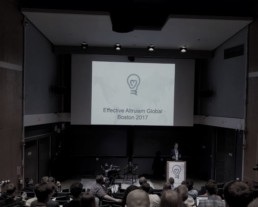
A movement must also have a conference. Enter EA Global – Boston. Not going to lie, I was as excited as a guinea pig for this one. It spanned two days at the Harvard campus where two hundred or so eager, effective altruists convened to listen to what’s next in the social impact world that is game-changing. Now picture this, the folks at this conference are at the confluence of two separate MO’s – on one hand we care about social impact, and we are a passionate bunch. On the other hand, we are also quant-nerds drowning are emotions in rationality. Combine these two divergent traits, and what you get are passionate social impact enthusiasts looking for a way to quantify everything. And honestly, it is this combination that makes the atmosphere electric, if that is your cup of tea. If not, then I don’t know how you made it this far in this post. The people I met there were highly intelligent and highly motivated, who cared to solve the worlds problem in the most rational way possible, and that is beautiful. The other thing that took me by storm was that even though this was social-impact-centric, the talks and things we were discussing were all game-changing technologies – AI, blockchain, genome editing, food-creation. That’s the crux – everything that matters has social impact tied to it – the sustenance of the friggin’ human race. And it wasn’t all about how all these breakthroughs are going to make the world a better place, but also around the real dangers associated with it – singularity, nuclear war, using data deceptively and so on. A girl next to me asked me what my story was, and the hero that I am, I gave her my shmeal, chummed about my prospects. And then, I asked her what brought her there and pretty casually, she said “I work in a lab where I grow meat, so we can stop animal cruelty and still enjoy a piece of steak.” Grow WHAT? She also said that she has succeeded and she has tried it, and all I could say was – “Is it gross?” She chuckled and said it wasn’t - in fact she trusted it more because she knew where it came from. And basically, she said we were pretty close to making real-fake meat sustainable. I was in love. These are the kind of conversations I left with.
Most of the talks were thoroughly engaging (there were a couple I just couldn’t follow and a couple that umm, uh yeah, let’s just leave it at that). The two that really stood out for me were:
- Max Tegmark’s take on existential risk and existential hope: He gave an eye-opening perspective on how nuclear war will not be an intentional act, it will just happen by mistake.
- Vikash Mansinghka’s breakdown of AI-assisted data analysis: This one was a little personal for me because I thought I understood data, because that’s what I did for a living. Not quite.
It was honestly an extremely enriching experience – I was surrounded by brilliant people, and it left me just wanting to read more and learn more and grow more. If any of this resonates with you, do give William Macaskill’s “Doing Good Better” a read – he does an entertaining job of explaining what effective altruism is all about. And if that hits home, go to one of these.
P.S. It was eerie to actually be in the presence of a couple of people whose books I had read and actually strongly believe in. I did a great job turning off fanboy mode though – got to keep it cool.

Next Steps

I’ve never been more excited. After galloping down the beaten path, I can’t help but be dramatic — it’s time for something new. I’ve studied hard and worked hard, climbed the corporate ladder, traveled the world, partied way too hard, on and in all kinds of clubs, speakeasies, and rooftops, lived in the greatest city in the world in an awfully comfortable apartment, met amazing people, built perennial relationships, and it has been friggin’ great. And still, hitting the eject button never felt so good.
But it’s not really the eject button, it is more of a delicate surgical extraction of sorts. Or honestly, I just grew a pair. I have been thinking about this for a while, but was constantly torn. “I am going to quit my corporate job, and just travel the world.” Yes, that sounds great but kind of useless, and self-centered much? Option two was — “Oh, I’ll work as a bartender on a beach in Thailand.” That’s fantastic — let’s just trash away everything I have learnt over the last decade. Option three resonates so much more. I am looking to take all that I’ve learnt in this stupendous, bittersweet, borderline-existential journey that has been Corporate America, and apply it to where it matters.
The social enterprise world has been like a dormant volcano in the back of my head that has recently exploded back into life. I read this book, thanks to my oh-so-amazing sister, and click, it switched on the lava flow. Jacqueline Novogratz is special. Her story is special. Her mind and her heart are special. It just makes so much sense.
If you make over $50k/year annually, you’re in the top 1% earning population of the world. Think again about not having ever won the lottery. And every dollar you make over $80k/year has a severe diminishing marginal utility when it comes to the age-old quest that is happiness. Please don’t be disillusioned by the illusion of happiness that comes with the extra money. Money matters, but only to a certain extent. There are only so many islands you can buy.
Whether this applies to you or not, it caused a massive earthquake in my psyche. Earn more money, and do what? So, here I was, sitting on coffers full of gold, earned earnestly by selling my soul to Corporate America. It was all hunky dory until my learning started to plateau and I started to somewhat implode — ironically, it was a blissful implosion of worthlessness, straight out of a Tarantino movie. And then, I quit.
HELLO WORLD. It’s like I am reborn. Never have I ever been more focused, and excited about my next steps. I have learnt so much, and I am so pumped to use what I have learnt and apply it to where I can actually make an impact. And the best part about this journey? I’ll be learning throughout. I suddenly prefer staying in and reading to going out and grabbing a drink. What is fiction? And, why would you? I can’t wait to sell all my stuff, and collapse my belongings into a suitcase. I can’t wait to explore the world with the purpose of looking to make a positive social impact. Income inequity is such a shame. Nothing against the rich, but let’s just raise the floor for the poor. There’s enough food to feed the world, but the seesaw is lopsided. Do your donations make the most impact possible? Why are ‘non-profits’ not called ‘for-purpose’? How can Burger King spend millions on advertising while for-purpose organizations get skewered for investing in scale? We are at the cusp of some sort of social enterprise renaissance. As data becomes easily available, the world is getting smarter. I want to be in the middle of it all. And yes, I might be wildly optimistic but this natural high is great. It’s the longest high I have ever had, and I am going to milk it. For once, I am not ashamed of being naïve. I am proud, excited and driven. All I am doing to protect myself is I am hedging my heart. Just a little though, just a little.
P.S. My first stop is Guatemala for 6 months where I will be doing a fellowship at Alterna, a social enterprise cultivator / incubator.